
Pride Is a Practice: TaskForce, Community, and the HR Infrastructure Behind the Mission
TaskForce Prevention Services has spent over 35 years centering LGBTQ+ youth on Chicago's West Side. As the only LGBTQ+-focused, youth-centered organization in the area, its work is both rare and necessary. We sat down with Executive Director Dr. Chris Balthazar to talk about the mission that drives him, the internal culture he is building, and why finding the right HR partner turned out to matter more than he expected.
Tell us a little about your journey to becoming the Executive Director of TaskForce.
What brought you to this work, and what keeps you motivated?
I never thought in a million years I would be running an organization. I was a research project director at Cook County Health, conducting HIV treatment and prevention research while adjunct teaching on the side. I was positioning myself for an academic career. My relationship with TaskForce actually started through community-engaged research. When the board asked me to step in as Executive Director, I started in April 2020, and it was: congratulations, you're the new ED — oh, and by the way, we have to close because of COVID.
I found my dream job. I love what TaskForce does. I love what it stands for. I love what it is today and what it will be tomorrow. This organization is about centering LGBTQ+ youth, and I don't think there's enough of that work happening across the city. I do this work because I know what it feels like to be a Black gay boy raised in Chicago, feeling like a unicorn, like there was no one like me. TaskForce is a space where young people don't have to feel alone. They get to see other people just like them. It builds community and supports young people to cultivate self-worth. That is preparing our young people to thrive.
Is there a recent moment that reminds you why this work matters?
Yes, and it's one of my favorites. Last summer, a teenager came to TaskForce for the first time. They made friends. And they told our staff, "This has been the best summer I've had in a long time."
Later, the young person's mother pulled a staff member aside and said, "My child doesn't have friends at school, but they made friends at TaskForce."
That is so powerful because I think that is the experience so many young people carry, feeling isolated, feeling like they are the other, like no one on earth is like them. In my previous experience as a school counselor, we were always concerned about kids who did not have friends. TaskForce is the place where young people get to see that they are okay, just the way they are. That they deserve love, value, and friends. They deserve to be centered and affirmed. When I heard that story, it reminded me: yes. This is exactly why we do what we do.
Morales Consulting is an LGBT-owned consulting firm.
When you're choosing partners to support your organization's internal operations, how important is it that those partners share not just your professional goals, but your lived experience and identity?
It was very important to us. One of the things I was most concerned about as the organization grows is that we do not forget who we are. We are an organization that supports and helps others, and that starts with our staff.
I wanted an HR partner who wasn't going to push us to be too corporate, but who could also help us find the balance between operating as a sound organization and recognizing that it is important for us to hire from the communities we serve and create structures that support people to actually thrive in their roles. That is tailored, custom-made work. That isn't something you can just pull from the textbooks and apply to any organization. It really takes someone who understands that community and shares those values.
When systemic structural baggage plays out in the workplace, it can potentially undermine what we stand for. Having a partner who can help us identify that in our policies and the way we do business is essential. It ensures that we do not cause harm to our staff, who are also part of that community.
Running a nonprofit that serves LGBTQ+ youth of color means your staff culture, hiring practices, and HR policies must reflect those values.
Almost a year in, how has this partnership helped TaskForce build an internal environment that mirrors the affirming spaces you create for the community you serve?
Is it fractional? Because I feel like Morales Consulting is fully embedded. We ask a lot, and y'all come through!
But seriously, it has been really helpful. We have had major policy issues within the organization that we had to address, and we have realized that just because another LGBT organization implements a certain policy doesn't mean it is a good fit for us. Through this partnership, we have been able to take a closer look at those policies and ask: how can we do better? How do we foster the level of support and cultural responsiveness we are trying to build?
Down to how we pay people, ensuring we are competitive and paying fair, livable wages. The kinds of training we provide. The resources we are identifying and building. A lot of that came to light through this partnership. From reviewing our handbook to making it more inclusive of staff voices, the approach has always had equity at the center.
How does having an HR partner that truly understands that experience shape the kind of workplace culture you're building at TaskForce, especially around how staff feel seen and supported?
I think it shapes it in a fundamental way. What we're trying to build internally has to match what we are building for the young people we serve. You can't create affirming, equity-centered spaces for the community and then run your own staff through systems that don't reflect those values.
Having a partner who gets it, not just professionally, but from lived experience, means we don't have to explain the why behind every decision. There is a shared understanding that grounds everything. That shows up when our staff feels more supported and heard. There is someone outside the organization who they can come to, and because it is outside, people feel like they are coming to a much more neutral space. On top of that, it is always a fair-minded, equity-centered approach that is also explained to staff. Everyone understands the process, even in difficult moments.
Julio [Martinez] is just phenomenal with how he communicates with all of the team members. Even when someone is the one being held accountable. Because the approach is: I am taking you along with me on this journey, and people respond to that.
For small- to mid-sized nonprofits doing critical LGBTQ+ community work, HR infrastructure isn't always the first investment.
What would you say to other executive directors about why getting HR right matters, and how a fractional model makes that more accessible?
You're right that it is often the last thing. And I understand why. There is always something else more urgent. But what I have learned is that your staff are your mission. If you do not invest in the systems that support them, you are undermining everything else you are trying to build.
The fractional model works because it gives you the full benefit of deep, ongoing HR support without the overhead of a full-time hire. You are outsourcing the expertise while holding onto the investment you would have put toward a salary and benefits, and you can direct those resources back into your programs and your people.
What I did not expect was how much the growth of TaskForce would be connected to having this kind of support in place. Our staff feels supported, our operations are more sound, and we are able to think expansively about staffing and sustainability because we are not starting from scratch every time something comes up. We are already in it, together. It allows us to grow. We are now serving young people city-wide, in some surrounding suburban areas, and we are preparing to move into a larger facility on the West Side. That momentum is not separate from the internal infrastructure work. It is because of it.
Finally, what do you want the social sector to know about the West Side of Chicago, and about the work TaskForce is building there?
We are the only LGBTQ+-focused, youth-centered organization on the West Side of Chicago. That is our gift to all of our West Side partners: the area of expertise. We provide some of the same services many other organizations provide, but we are the only ones who know what it means to truly center LGBTQ+ youth. It allows us to work very synergistically with community-based organizations across the West Side and throughout the city.
What we are building here is not small. We are expanding our impact because not enough organizations like TaskForce exist. We are looking at a much larger office space. We are working toward becoming the space our young people need, more broadly, because we know it is needed. And we are not going to stop until that is real.
Pride Is a Practice
Morales Consulting is immensely grateful to Dr. Chris Balthazar for his time and his partnership. His leadership at TaskForce Prevention Services is a reminder that the most powerful organizations are built from the inside out, and that Pride Month is not just a moment of celebration but a call to sustain the work year-round. We are honored to be part of that effort alongside him and the entire TaskForce community.
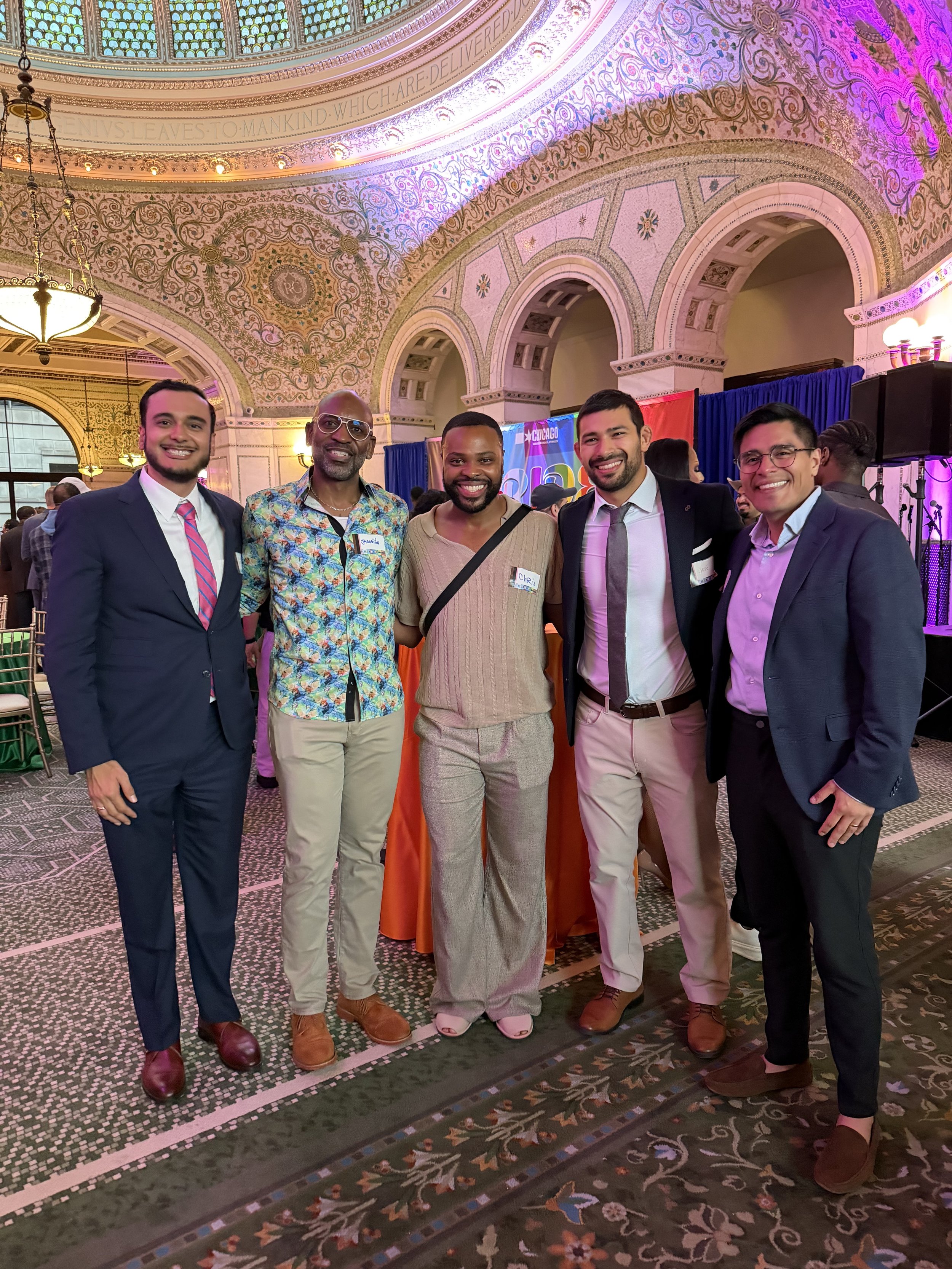
Morales Consulting meets with TaskForce Prevention Services at the City of Chicago Mayor’s Pride Month Reception event held at the Cultural Center Chicago on June 23, 2026.
From left to right: Alberto Morales, Jagadīśa-devaśrī Dācus, Dr. Chris Balthazar, José Mazariegos, and Julio Martinez